Graph-Based Codebase Comprehension at Scale
Graph queries help agents and reviewers understand architectural impact at scale.
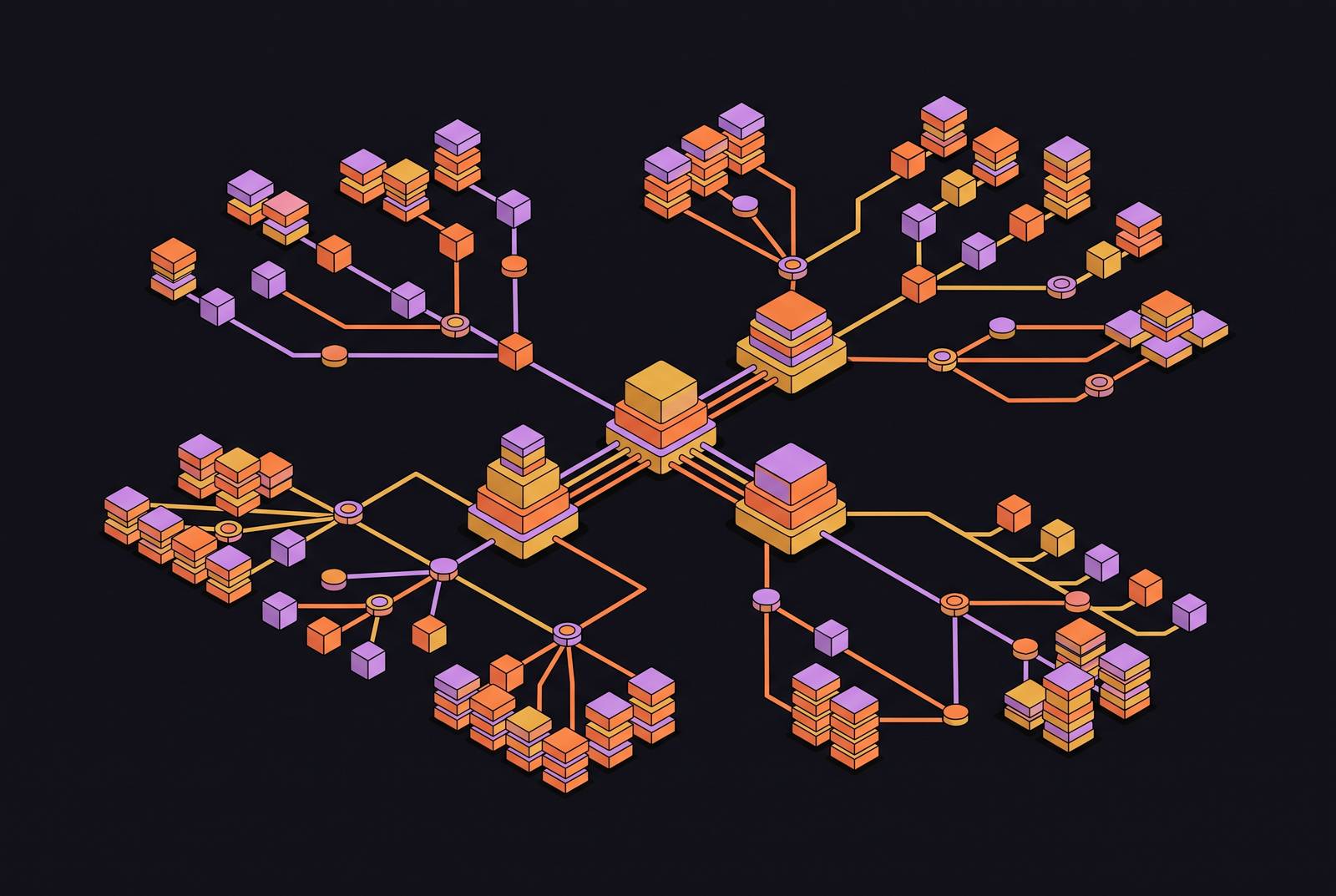
Architecture drift in AI-generated codebases occurs when locally acceptable changes erode the system’s intended boundaries, dependencies, and reuse. Graph-based codebase comprehension at scale addresses this by making relationships queryable for agents, visible to reviewers, and enforceable in CI. When code grows faster than humans can read it, the graph must become an architectural contract.
Why AI agents break the assumption that developers can read what they ship
The 2025 DORA Report identifies a “verification tax” in which time saved generating code moves into auditing output and refining prompts. The same report associates high AI adoption with rising bug rates, longer code reviews, and larger pull requests. Generation and verification do not scale together. As changes spread across more files, reviewers must establish not only whether each edit is correct but whether the edits remain coherent as a system. A readable diff no longer establishes an understandable change.
An MSR 2026 study of agent-authored pull requests across GitHub found that unmerged requests tended to touch more files, make larger changes, and fail CI. Blast radius can thus show how hard a change will be to merge before it becomes part of the codebase. The January 2026 study “More Code, Less Reuse” identifies a less visible problem. Agent-generated code can appear polished and pass tests while introducing redundancy and maintainability debt that reviewers miss. Surface quality does not establish structural soundness.
The Anthropic 2026 Agentic Coding Trends Report finds that developers use AI in roughly 60% of their work but fully delegate only a small fraction of tasks. Yet oversight becomes harder when the output requires more context than the reviewer can reconstruct within the review. The gap is not simply between writing speed and reading speed, but between producing an implementation and understanding its consequences. If reading cannot keep pace with that responsibility, what replaces reading as the basis of comprehension?
Why reading files is the wrong unit of comprehension for a graph-shaped problem
The question “What breaks if this function changes?” asks about relationships. To answer it, a reader may need to follow callers, dependencies, and module boundaries beyond the changed code. Reading the function is only the starting point. Each file that follows adds another piece, and the reader must keep track of the connections while deciding where to look next. The work is a repeated reconstruction of structure that the repository already contains implicitly.
Codebase-Memory explains that text search cannot capture transitive relationships without iteratively following references. Each iteration consumes more tokens and introduces another opportunity to lose context. The same paper describes sessions spent exploring the structure of files that use hundreds of thousands of tokens, with LLM API costs of several dollars per task on non-trivial repositories. Search results alone do not show the dependency chain that links a distant function to the change.
The mismatch also affects what a model understands after finding the code. CGBridge research describes a model that correctly summarizes a function but fails after a variable rename, exposing reliance on surface tokens to interpret structural semantics. Containment, invocation, inheritance, and data flow exist as relationships, while both model inputs and conventional reviews present them as linear text. Adding more text leaves the central burden intact, because the reader must still infer which relationships govern the change.
What a graph-based code representation actually encodes and why that matters for comprehension
A code graph represents program entities as nodes and their relationships as typed edges. Nodes can denote files, classes, functions, or statements, while edges distinguish containment, imports, invocation, inheritance, data flow, and control flow. The edge type gives the connection meaning. A function contained in a class and a function called by that class participate in different relationships, even if both appear near the same name in a search result. Queries can follow those distinctions without requiring a fresh reading of the source text.
The canonical graph types, including AST, CFG, DFG, PDG, and CPG, capture different layers of program semantics. Heterogeneous graphs combine these layers so that an investigation can cross from one kind of relationship to another. LocAgent (ACL 2025) provides a concrete example. It parses repositories into directed heterogeneous graphs of files, classes, functions, imports, invocations, and inheritance. Its multi-hop reasoning links a natural-language issue to the parts of the code it affects, even when the issue never names them.
Hierarchical representations address the further problem of repository size by partitioning code into dependency levels, from leaves through intermediate modules to top-level files. With those levels, summaries can be built from the bottom up for repositories too large to fit in any context window. Detail remains connected to its wider setting. For an impact question, the practical difference is traversal rather than reconstruction, because the graph follows recorded relationships instead of asking the reader to infer them from every changed line.
How graph-guided agents navigate and localize code more effectively than retrieval alone
A pre-built graph index changes an agent’s investigation from repeated file discovery to directed navigation. For questions about structure, that can mean fewer tool calls and less token use, with results that are as good or better on architecture-heavy tasks. Aider’s repo map applies a compact version of this approach. It combines tree-sitter parsing with PageRank to produce a token-budgeted structural summary before editing begins.
CodexGraph (NAACL 2025) makes that structure available through a code graph database. It enables graph queries against the repository, treating code as a queryable system. This changes the unit of investigation. An agent can ask for a relationship and follow it across program entities, instead of hoping that the files it needs use the same words as the original issue. That distinction becomes useful when the affected region is connected by architecture but not by obvious textual similarity.
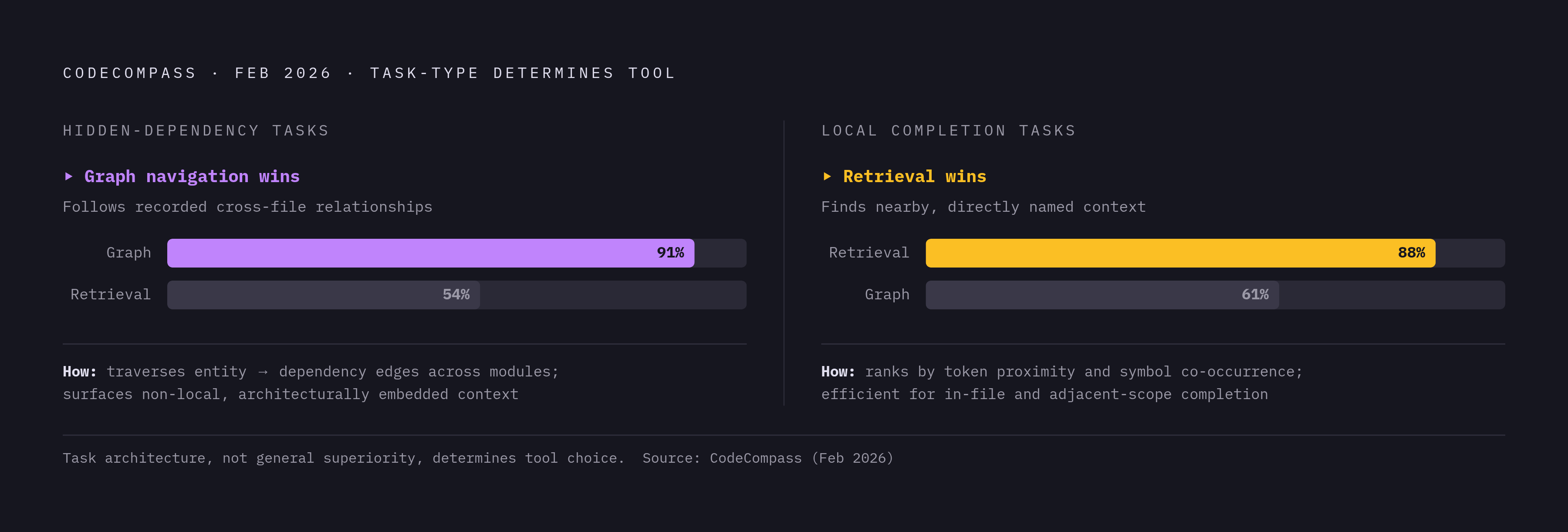
Retrieval nevertheless has a strong claim on local tasks. If the required context is nearby and directly named, graph navigation need not be the best way to obtain it. The February 2026 paper “CodeCompass: Navigating the Navigation Paradox in Agentic Code Intelligence” resolves this comparison by task type. It finds that graph-structured dependency navigation outperforms retrieval on hidden-dependency, architecturally determined tasks, while retrieval wins on local completion. The case for graphs is therefore not that they replace grep everywhere, but that architecture-level questions require access to relationships that retrieval alone does not expose.
Why comprehension at the human level requires the same graph the agent uses
The structural context that helps an agent find the right code also gives the reviewer a basis for judging its changes. As implementation is delegated, the developer’s responsibility shifts toward defining architecture, context boundaries, and intent. Those responsibilities require a shared map of the system. If the agent navigates explicit dependencies but the reviewer sees only changed lines, the two sides are evaluating the work through different representations. The reviewer must then repeat the structural discovery that the agent’s graph already supported.
A forty-file diff illustrates the cost of that separation. The interface organizes evidence by file and line, although architectural review concerns which relationships changed and which boundaries those changes cross. By showing affected files and functions, color-coded by distance from a change, it exposes transitive impact before the merge decision. The reviewer can examine the scope of the change rather than infer it solely from the size and location of the edits.
SWE-chat data shows that users pushed back in a substantial share of agent turns and that only a portion of agent-produced code survived into commits. Human judgment already filters the output during development. A graph interface gives that judgment structural evidence, making it faster and more reliable without substituting a diagram for engineering intent. It connects the agent’s navigation to the human’s decision about whether the result belongs in the system. Without that shared model, review becomes another attempt to read enough code to reconstruct the architecture.
How do you detect AI-generated code diverging from intended architecture in CI?
Architectural drift becomes detectable at the merge gate when intended boundaries are expressed as executable constraints on the graph. A CI check evaluates those constraints, exits non-zero when it finds a violation, and blocks the merge. A diagram records intent while leaving an agent optimizing for local task completion free to introduce a globally invalid dependency.
ContextCov (2026) demonstrates the underlying mechanism by constructing a dependency graph and enforcing layered structure during agentic generation. An attempt to create a file in an invalid location receives immediate feedback identifying the broken rule. The checks do not require LLM judgment. File path analysis and import graph traversal can deterministically detect layer violations, cyclic dependencies, and module placement errors. These are concrete signals of divergence from architectural constraints, rather than general assessments of whether generated code looks maintainable.
Nx maintains project and task graphs with enforced boundaries across TypeScript, Gradle, Maven, and.NET, with community support for Go. It also uses the graph for affected-task computation and caching in CI, connecting structural knowledge to both what runs and what is blocked. The scope of that graph remains important. Cross-repository infrastructure dependencies, including Terraform modules, Docker base images, and shared CI templates, still require manual registration or separate discovery. Package-level enforcement does not close that gap, so a passing check cannot establish compliance for relationships outside the represented system.
What the graph-as-contract model requires from the development workflow
The practical workflow begins by treating the graph as a repository asset. It must live in the repo, version with the code, and remain queryable without external infrastructure. Initialization captures modules, files, classes, functions, and call relationships. Agent work is then planned against that structure, with architectural boundaries defined before implementation. After generation, CI compares the resulting graph against the predefined constraints and rejects violations.
This model also changes the primary review interface. Under “delegate, review, and own,” the engineer must review architectural impact. The graph belongs at the start of review. It shows where the agent’s work sits within the system and which relationships need judgment, while the source is still there for a closer look at implementation details.
The strongest objection is that interactive filtering already catches agent mistakes and retrieval handles many local tasks well. That objection distinguishes two useful activities but does not make them interchangeable. Interactive correction fixes errors found within the session. Pre-merge graph enforcement catches cross-cutting constraint violations that are visible only across the whole codebase, including changes whose implementations look acceptable on their own. The workflow needs both local judgment and a system-wide contract because neither passing tests nor approving isolated edits establishes architectural compliance.
The operational standard is a graph in the repository, executable constraints in CI, and architectural impact as the review interface. Its authority depends on the relationships it represents and the rules the team defines. Unrepresented dependencies remain outside the contract’s protection. Where agents keep producing code faster than humans can reconstruct its structure, leaving that contract implicit makes architecture drift a certainty that remains uncontrolled at merge.
Sources
- Codebase-Memory: Tree-Sitter-Based Knowledge Graphs for LLM Code Exploration via MCP
- Bridging Code Graphs and Large Language Models for Better Code Understanding
- LocAgent: Graph-Guided LLM Agents for Code Localization
- 2026 Agentic Coding Trends Report How coding agents are reshaping
- CodeCompass: Navigating the Navigation Paradox in Agentic Code Intelligence