Scaling AI Agents From Pilot to Production Fleet
Most AI agent pilots fail to reach production scale due to operational gaps, not technical ones.
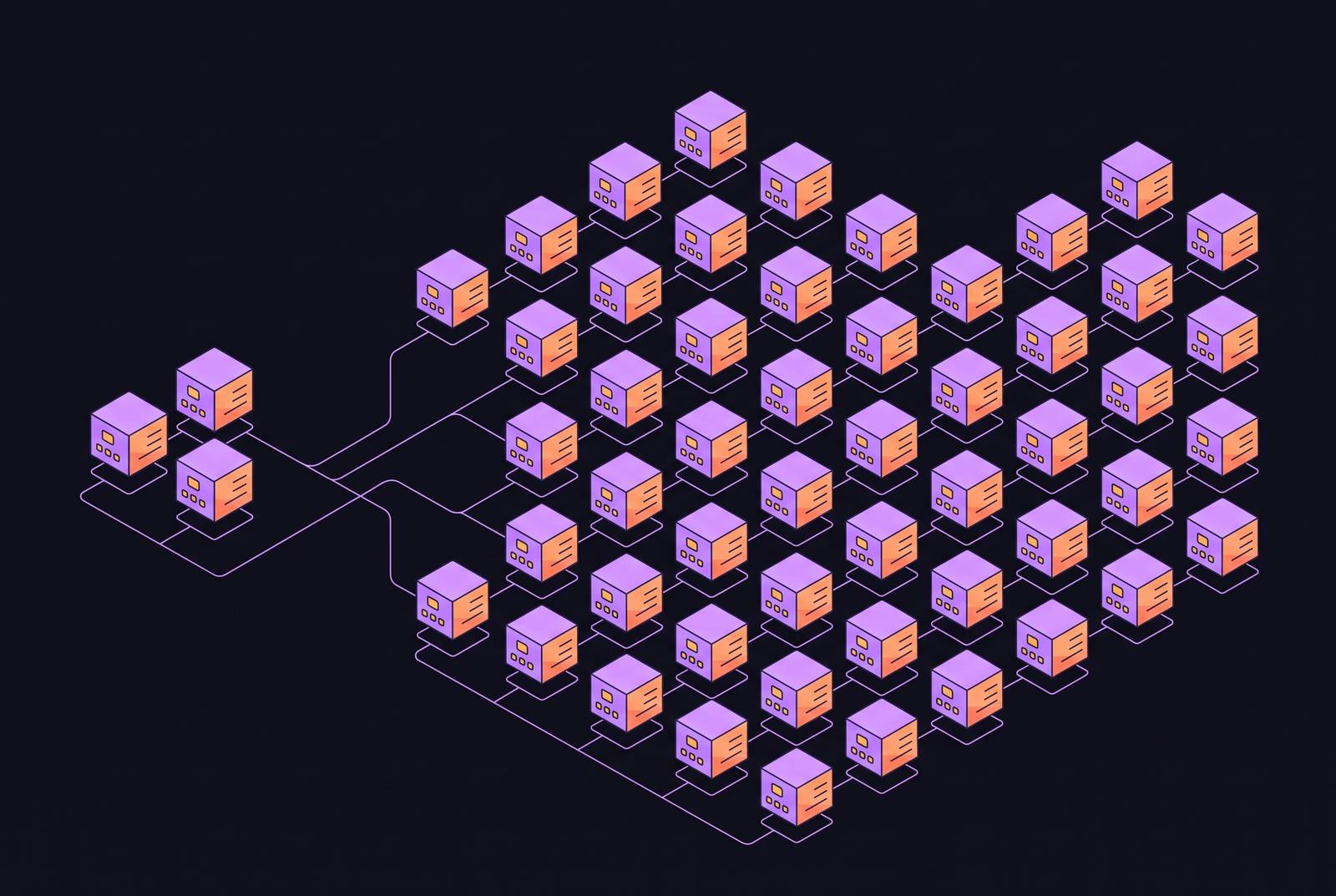
A survey of 650 enterprise technology leaders found that most enterprises already have at least one AI agent pilot running, but only a few have scaled it up to organization-wide production use. The gap between those two numbers is the subject of this article, and it is wider than most teams expect when they greenlight their first pilot. The gap points to an operational failure rather than a technical one: the same model powering a successful pilot often underperforms once it's deployed at scale, even though the underlying models are ready. The five root causes cited most often in the survey, integration complexity, inconsistent output quality at volume, absent monitoring, unclear ownership, and insufficient domain training data, don't operate independently. An ownership gap leaves a monitoring gap unfilled, and that unfilled monitoring gap is what lets quality problems accumulate quietly until they're too large to ignore.
Part of the problem is baked into what a pilot is designed to measure. A pilot answers a narrow question: can this agent do the job under favorable conditions? Production asks a much harder one: can it do the job every time, for every input, including the ones nobody thought to test? That shift in the question, from favorable conditions to unbounded conditions, is where most pilots quietly stall. The rest of this piece maps what changes when a team crosses that line, the failure modes specific to coding agents that only appear at volume, and the infrastructure that separates the organizations running stable production fleets from the ones still running the same pilot they started eighteen months ago.
What changes structurally from pilot to fleet
A pilot is a controlled environment built to hide the complexity an agent will eventually face in production. Scaling it up doesn't just add more of the same traffic, it exposes the agent to an entirely different operating category. Pilots run on curated inputs, narrow task scope, close human oversight, and test scenarios chosen in advance because they're known to work. None of those four conditions survive contact with real production traffic.
Production agents encounter typos, slang, mixed languages, adversarial prompts, account states nobody anticipated, and multi-step problems with no scripted resolution path. This long tail of edge cases rarely appears in a two-or-three-week pilot, because it isn't running long enough or broadly enough to hit them. Infrastructure requirements shift just as sharply as input complexity does. A pilot agent fielding a handful of requests a day behaves, for practical purposes, like a sequential system: one request in, one response out, a human watching the whole time. A production fleet needs load balancing, request queuing, asynchronous processing for long-running tasks, and auto-scaling that can respond in minutes, not hours.
Integration surface area follows the same non-linear curve. A narrow pilot might connect to one or two clean, well-documented data sources. A production fleet connects to dozens of legacy systems, and each one has its own schema, its own update frequency, and its own way to fail. Every one of those connections multiplies latency variability and authentication complexity, and the multiplication is compounding rather than additive: each new system doesn't just add its own risk, it interacts with every other system already in the fleet.
The failure modes that emerge specifically at fleet scale for coding agents
For coding agents, fleet scale brings failure modes you can't see at pilot scope, because they are properties of the whole codebase built up over time, not properties of any single agent session. An agent reasons locally: it sees the file open in front of it, the function it was asked to write, the immediate caller it needs to satisfy. It does not see the lineage of that module, the schema contracts downstream systems depend on, or the architectural rules that determine a given change's safety across the rest of the codebase.
A concrete example from the research illustrates the mechanism precisely. An agent tasked with adding a utility function for file path normalization placed it in the directory where the immediate caller lived. But the codebase's layered architecture required that function to live in the foundation layer instead. Locally, the agent's decision was reasonable: the function was right next to the code that used it. Globally, it was wrong, and because the violation is subtle, it compounds silently when the same pattern repeats across a fleet of agents working in parallel.
This local-versus-global mismatch appears in measurable form. GitClear's report, built on hundreds of millions of code changes, tracked a sharp rise in duplicated code blocks as AI authorship of those changes grew, a signal that agents are optimizing for finishing the task in front of them rather than for coherence with the rest of the design. A separate and distinct failure mode is agentic drift, the divergence between what a developer actually intended and what an agent ultimately produced. Existing review tooling was never built to catch this kind of divergence, because it's a mismatch between intent and output, not a syntax or logic error. Researchers at arXiv introduced a system called ARCTIC in July 2026 specifically to address it: ARCTIC predicts developer intent from conversation logs, measures how far the agent's actual output diverges from that predicted intent, and reached near-perfect agreement with human annotators doing the same judgment manually.
The most dangerous property of a fleet is what might be called the amplifier effect. When the underlying architecture is clean, a fleet of agents accelerates good work across the whole codebase. When the architecture is already drifting, the fleet accelerates the drift at the same rate. An unconstrained fleet is worse than an unsupervised junior developer because the fleet operates at a volume and speed no junior developer could ever match, not because any single agent writes worse code.
Large diffs as the wrong interface for fleet-scale problems
Traditional code review, even with AI assistance layered on top, was designed for human-paced, human-scoped changes. It was built for diffs scoped to human pace, not for diffs that span dozens of files and multiple architectural layers in a single prompt's output, which is what fleet-scale agent activity produces. A single prompt can touch dozens of files and generate thousands of lines of diff in one pass. At that volume and that breadth, a linear diff obscures the conceptual structure of the change entirely, leaving a reviewer able to assess syntactic correctness but not whether the change respects the architecture it's modifying.
Existing AI code review tools compound the problem by over-indexing on low-value signals, style, naming conventions, generic best practices, while under-indexing on the three concerns human reviewers actually prioritize: correctness, security, and architectural coherence. Salesforce's engineering teams observed this pattern directly: AI intensified the large-PR pattern already present in their codebases, generating more code per task across unrelated files and architectural layers, with reviewers navigating linear diffs that obscured the conceptual structure of the change.
Meta's RADAR system is the clearest evidence of what automated review at fleet scale actually demands. RADAR has reviewed hundreds of thousands of diffs, reaching tens of thousands per day, and its revert rate is a fraction of what manually reviewed diffs see, with a meaningfully reduced median time-to-close. Meta invested in classifying risk, routing each change to the correct review tier, and measuring outcomes continuously, and that is where RADAR's results come from, not a more sophisticated diff viewer. Cloudflare's approach reflects the same structural insight from a different angle: every merge request gets classified by size and nature before any review resource is allocated to it. Sending compute-intensive review to a trivial change wastes capacity. If you send a fast, shallow check to a high-risk architectural change, you're asking for a failure.
A diff, by its nature, shows what changed line by line, which is the deeper issue underneath both examples. It does not show whether what changed is consistent with the design the team actually intended. You need a different kind of artifact than a diff to catch that kind of violation.
What enforcement infrastructure separates production fleets from stalled pilots
Teams running stable production fleets are not reading agent output more carefully than everyone else. They are encoding architectural rules into systems that make violations physically impossible to merge. That distinction, enforcement instead of review, is the argument's turning point: enforcement prevents a problem from shipping at all, where review only catches it after it ships.
Architecture tests are fully deterministic once they're integrated into a CI/CD pipeline: a violated rule blocks the build from passing. It's a binary gate, not a warning buried in a review thread or a comment an agent can argue its way past. Research on agent governance describes this as a "substrate" convention: each architectural rule gets enforced by a tool that runs before the code does, a strict linter, a type checker, a runtime contract validator, so that neither the agent nor the human reviewer has to remember a rule the tooling has already encoded on their behalf. OpenAI named this discipline "harness engineering": the combination of testing, monitoring, architectural constraints, and orchestration infrastructure that governs how agents generate, modify, and maintain software. By 2026, harness engineering is increasingly treated as a prerequisite for scaling an agent fleet safely, not an optional layer bolted on after the fact.
The survey backs this up with spending data: organizations that successfully scaled their pilots spent proportionally more on evaluation infrastructure, monitoring tooling, and operational staffing, and proportionally less on model selection and prompt engineering, than organizations that stalled. The leverage sits in the harness, not in which model is doing the generating. Change failure rates rise substantially where agents can trigger deployments directly unless constitution-level constraints, never deploy without passing integration tests, require human approval for production releases, are enforced automatically in the system itself. Salesforce's Agentic Enterprise Index found that when organizations completed a structured production readiness program, they reached production performance close to their pilot benchmarks, but when they skipped it, a large gap opened up between the two. The readiness program is, functionally, a harness-building exercise.
Navigating a live architecture graph instead of reading diffs
Enforcing architectural constraints in CI requires the architecture to be defined somewhere explicit enough for a machine to check against it. A living, version-controlled graph of the codebase is the natural place to define and verify that architecture, because it makes the structure agents are supposed to respect visible in the same artifact that enforces it. A diff shows what changed, line by line. A graph of modules, files, classes, functions, and the call relationships between them shows what the codebase actually is, and whether an agent's latest output is still consistent with what it's supposed to be.
The utility function placed next to its caller instead of in the foundation layer it belonged in is exactly the kind of local-reasoning failure a graph-based constraint is built to catch. The graph encodes which modules are allowed to depend on which others, and a violation of that rule exits non-zero in CI before the change ever reaches a human reviewer. Graphide, currently in closed alpha, maps a repository into a live, interactive architecture graph and runs a check in CI to enforce those constraints automatically, giving a team the binary gate harness engineering calls for without having to build a constraint system from scratch. The graph lives inside the repository, versions alongside the code, and gets enforced in CI, so it works as the team's source of truth, not a diagram someone drew once in a planning meeting and never updated again.
Detecting agentic drift, the gap between what a developer intended and what the fleet actually built, requires visibility into the structural state of the whole codebase, not just review of one diff at a time. When you map a codebase as a live graph, you can catch a violation like the misplaced utility function the moment it happens, instead of discovering the pattern weeks later after it has already repeated across dozens of files. For a team directing a fleet of agents rather than a single one, the graph doubles as the interface for planning that work: developers can watch what the fleet is building as it happens, spot where the design is drifting from the intended architecture, and correct course directly on the graph, replacing review inside a two-thousand-line diff.
The organizational practices production fleet operators share
The technical infrastructure covered so far, CI gates, architecture graphs, enforced constraints, only works inside an organization set up to use it. Teams running stable production fleets share a set of organizational habits that matter as much as the tooling itself, and most stalled teams are missing at least one of them.
- Scope discipline: successful deployments started with agents scoped to a single, well-defined task with measurable output, and only expanded scope after that narrow version had run stably for an extended period. Agents assigned broad, open-ended tasks from the outset failed at scale, because quality variance compounded and edge cases became untestable before anyone could catch them.
- Build-versus-operate rebalancing: survey data shows stalled and successful organizations spending roughly the same total AI budget. Successful scalers put proportionally more of that budget into evaluation infrastructure and monitoring and less into model selection, which suggests most stalled teams are overspending on the build and underspending on the operate.
- Role stratification: PwC's Agentic SDLC report found that pioneer organizations, those using generative AI across many stages of the software development lifecycle, report markedly higher release cadence and sharply lower defect rates than their peers. The engineers driving those results are designing AI-augmented systems, validating agent behavior, and owning production reliability.
- Monitoring before scaling: survey data shows a high rate of observability already in place among organizations running agents in production, while organizations still stuck in pilot phases often have none. Teams that try to build monitoring infrastructure at the same time they scale volume consistently end up rolling the deployment back.
The real gap between pilot success and production failure is operational at its core: teams pilot an agent without the infrastructure to observe and constrain its output at scale, then expect production to behave the same way it did across ten carefully chosen test cases. Closing that gap takes infrastructure that gives developers continuous visibility into what agents are building against the architecture they were meant to build toward, not after-the-fact diff review, but live observation of the codebase as it changes. The tools to do this exist now. What separates a production fleet from a stalled pilot is whether the engineers running it are organized to design the harness, define the architectural constraints, and own the graph, rather than leaving the architecture to erode one locally reasonable decision at a time.