Claude Code for Architecture-Aware Development
AI agents preserve codebase architecture through constraints embedded before generation, not after.
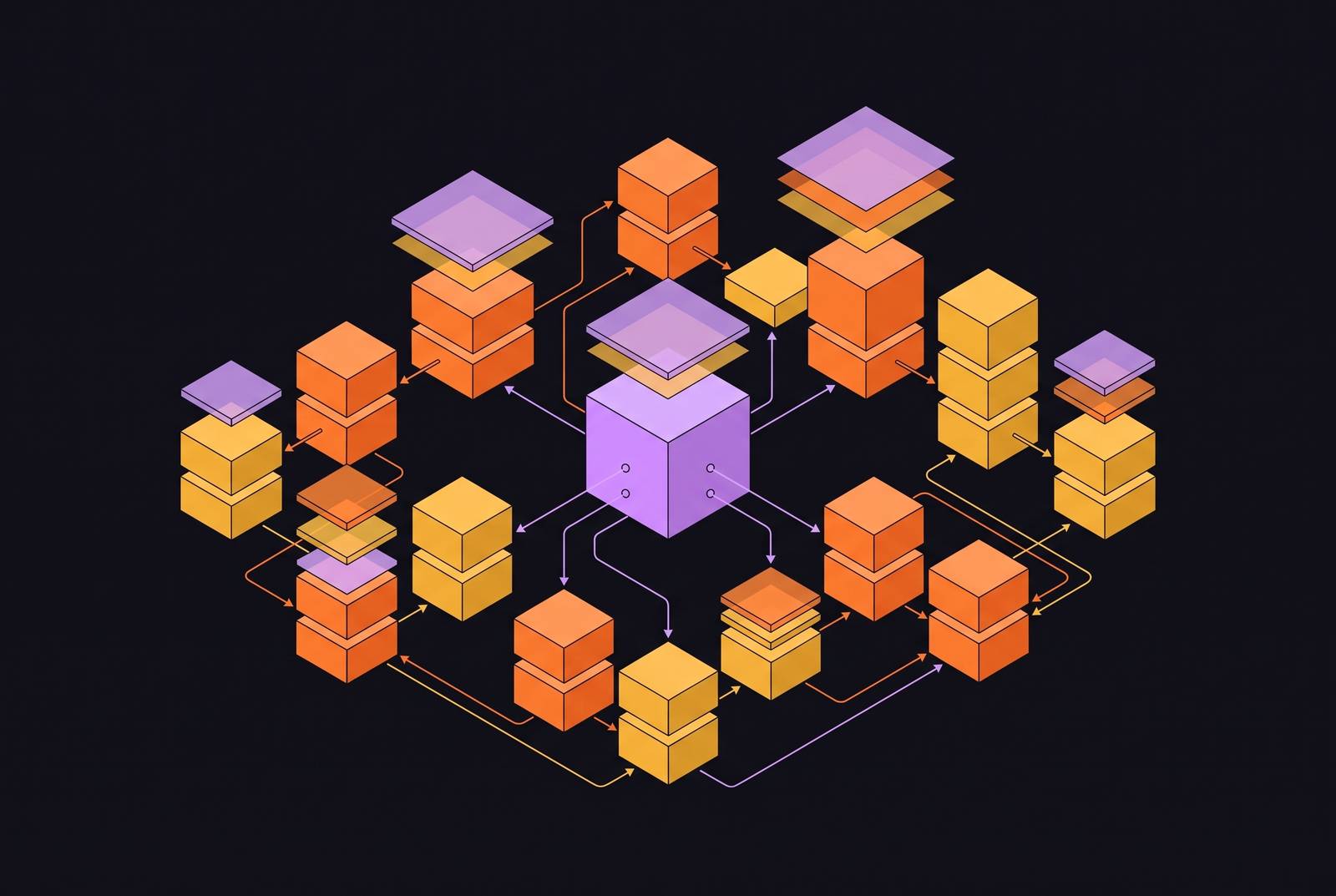
Claude Code executes. It does not wait for your approval before every file write. It runs shell commands, edits files across the repository, and calls external services as an agent acting on the developer's behalf. That autonomy is the source of its leverage, and it is also the reason architecture-aware development demands constraints that live outside the prompt.
What Actually Gives an AI Coding Agent a Real-Time Map of the Codebase
The question is not whether Claude Code can generate working code faster than a human. It can. The question is what happens to the structural design of a codebase when an autonomous loop touches forty files in a single session and no individual reviewer can track the whole intervention. The answer depends on whether the developer configured the agent to respect architectural boundaries before it started, and on whether the developer has a way to see structural change as it happens rather than reconstructing it afterward from a line-level diff.
Claude Code's core is a while-loop: call the model, run tools, repeat. A source-level analysis of the publicly available TypeScript codebase identifies this loop as the system's fundamental structure, autonomous by design rather than by accident. The loop can process on the order of tens of thousands to around one hundred thousand lines of code in a single session without fragmentation. A single prompt can coherently touch a substantial portion of a codebase, which is precisely what makes the tool valuable for a developer orchestrating a large change. It is also what makes a constraint violation expensive: by the time the loop has finished, the architectural drift is embedded across the resulting diff.
This tension is not a matter of careless use. A study of the constraint problem, identifying an effect its authors call "constraint decay," found that imposing a structured architecture such as Clean Architecture costs a meaningful number of percentage points of assertion pass rate, and that stacking multiple constraints compounds the loss substantially. Agents are strongest at unconstrained generation and measurably weaker in convention-heavy environments. The question is how to structure the environment so that the conventions survive without relying on the model's willingness to honor them.
The answer begins with what Claude Code already provides. Most of its codebase, about 98.4%, is operational infrastructure: permission systems, context management, and four extensibility mechanisms. Only about 1.6% is AI decision logic. The system is engineered for reliable autonomous execution, so the raw material for architectural control is already present in its design. The developer's task is to activate it.
How the Agentic Loop Degrades Architectural Integrity as Constraints Accumulate
The agentic loop's failure mode is not random. It is a predictable consequence of how language models respond to accumulated instructions. A model asked to generate a solution without architectural constraints will produce more working assertions than the same model asked to honor layered boundaries and dependency rules. The constraint-decay finding shows that prose rules, added as constraints in the prompt, degrade correctness rather than improving it.
Proponents of agentic tools sometimes respond that the developer should simply write better prompts. The data does not support that response. Prose constraints decay as they accumulate. Deterministic enforcement applied externally to the model persists regardless of the model's interpretative capacity. The implication is that the matching principle for agentic development is to move every checkable constraint out of the prompt and into configuration or a build step.
This problem is made visible by the size of agent output. One prompt can touch forty files. A careful reading of a diff that spans that many modules is not better version of a smaller review. It is a different cognitive task, and the evidence is that defect detection degrades substantially past a certain diff size threshold. In related research, AI-assisted pull requests arrived at a median size substantially larger than unassisted ones, with defect detection falling off past roughly 400 lines. Agent-generated code also arrives without the decision history a human author carries: the discarded alternatives, the active constraints, the reasoning behind a boundary. A reviewer looking at the diff must reconstruct intent from the output alone, and at agent scale that reconstruction is unreliable.
The architectural risk is therefore not that an agent occasionally writes a controller that touches the database. It is that the work environment provides no fixed point against which to judge the change. Without a structural view of what the agent did, architectural erosion is invisible until a future change collides with it.
What Claude Code's Architecture Actually Gives You to Work With Before Writing a Line of Prompt
Claude Code's four extensibility mechanisms, MCP, plugins, skills, and hooks, are not equal in their cost to the model's finite context window. Hooks consume zero context by default, but a hook can opt into injecting additional context when it returns output. Skills consume low context because their descriptions load with each request. MCP servers consume high context once their tool schemas load. Plugins are the packaging layer that bundles skills, hooks, subagents, and MCP servers into one installable unit.
This hierarchy is itself an architectural decision. If you understand the context economics, you will place lightweight rules that must fire on every action in hooks, conventions the model should recall in skills, and heavier tool integrations in MCP servers. The choice of mechanism has direct consequences for what constraints can be embedded without degrading the performance of the model they are intended to guide.
The CLAUDE.md file is the project's persistent source of truth. It survives across sessions and defines the conventions, boundaries, and constraints the agent has to honor. Skills are model-invoked: Claude activates them based on task context, without the user asking, so a code-review skill that fires whenever Claude modifies code functions as a soft pre-generation constraint. The permissions.deny setting in.claude/settings.json prevents Claude Code from reading sensitive or irrelevant paths, so the agent can only touch the parts of the codebase you intend it to reach.
The source-level analysis of Claude Code identifies five design values in its construction: human decision authority, safety, security, and privacy, reliable execution, capability amplification, and contextual adaptability. The tool is oriented toward controllability. The developer's job is to put that orientation to work. The mechanisms remain theoretical until paired with a way to see what the agent has decided to build, and a tool such as Graphide, which renders the codebase as a navigable, editable architecture graph, gives a developer a view of the agent's decisions against the structural model defined before the prompt was written.
Embedding Architectural Constraints Before the Agent Generates Code
Pre-generation constraint embedding is the only way to influence the agent's structural choices at the moment they are made, rather than after the diff lands. The rule types that can be encoded this way are concrete: layered separation, so controllers never access the database directly; dependency inversion, so code depends on abstractions rather than concrete implementations; and bounded context boundaries for domain-driven design. Each of these maps to a mechanism in Claude Code rather than to an instruction buried in the prompt.
The failure mode these controls prevent is what practitioners call the "fake confidence loop." If the same model proposes a fix and writes the tests that approve it, a human is approving structure they cannot see. The rule is never to let the same model both propose the fix and verify the constraint it was supposed to honor. Subagent role separation, with Architect, Auditor, and Implementer personae, maps directly onto Claude Code's subagent delegation and orchestration mechanism. Assigning architectural review to a separate agent persona rather than the implementing agent breaks the self-confirmation loop at its source.
This configuration work has to happen before the prompt is typed. A constraint added mid-session is a suggestion to a model already committed to a decomposition, and it competes with every other instruction in the context window. Claude Code's extension mechanisms provide the raw material for architectural control, but the control has to be in place before the loop starts, not improvised while it runs.
Post-Generation Enforcement: Architectural Rules That Fail the Build
The practitioner principle that frames post-generation enforcement is blunt: the agent respects the boundary that fails the build, and ignores the one in the diagram. A prose rule in CLAUDE.md is an expectation. A check that exits non-zero in CI is a fact of the pipeline.
Architecture tests in this category, ArchUnit, dependency checkers, and similar tools, operate as fitness functions rather than documentation. They encode the rule as executable logic, and a CI gate evaluates that logic on every merge. A violated rule physically prevents the build from passing. Prose documentation cannot approach that compliance rate because prose requires a reader to notice the violation and act on it, and a CI failure requires no judgment at all.
The gr check pattern is the direct operationalization of this principle. It runs an architectural constraint check as a CI gate that exits non-zero and blocks a merge when the constraint is violated. The graph-as-enforcer checks structural relationships against the intended architecture, and the change does not merge until the relationships hold. Graphide implements this pattern, and the point of the pattern is that the architecture graph becomes an enforcement mechanism, not a diagram that lives in a wiki.
Enforcement in CI has properties that prompt-level rules do not. It is version-controlled alongside the code it governs, so the constraint evolves with the codebase. It survives team turnover, because it does not depend on institutional memory about which rules matter. And it applies to every agent run, not just the ones a developer remembers to review carefully. If you combine pre-generation guardrails with deterministic, CI-integrated architecture checks, what the agent builds is not just locally coherent but verifiably aligned with the codebase's structural design, so drift gets caught before it reaches production.
Why the Diff Is the Wrong Interface for Verifying What an Agent Built Across Forty Files
A diff is a linear, local view of changes: this line was added, that one was removed. An agent's output is a relational, cross-file intervention that changes which modules depend on which and where boundaries sit. The mismatch means that reviewing a large agent-generated diff in a standard pull request interface degrades review quality as the diff size grows, because the interface cannot show the structural consequences of the change.
The verification bottleneck is concrete. An agent implements a feature in minutes. A careful review plus manual testing can take many times longer. "AI speed" therefore translates in practice to a cycle dominated by verification, not generation. The developer's calendar fills with review work that the increased generation rate has made unavoidable, and the bottleneck shifts to an interface that was never designed for the volume.
The answer is not to run slower agents or to insist on smaller diffs. It is to change the interface. A living architecture graph shows what the agent changed at the structural level: which modules moved, which call relationships formed, which boundaries were crossed. That is the information a reviewer needs to judge whether an agent respected the architecture. The line-level diff cannot provide it, which is why a developer steering an agent through the architecture of a codebase benefits from a tool such as Graphide that renders the structural changes as a navigable graph rather than a list of file patches.
The Developer's Actual Job When Claude Code Is Running: Configure First, Steer During, Verify After
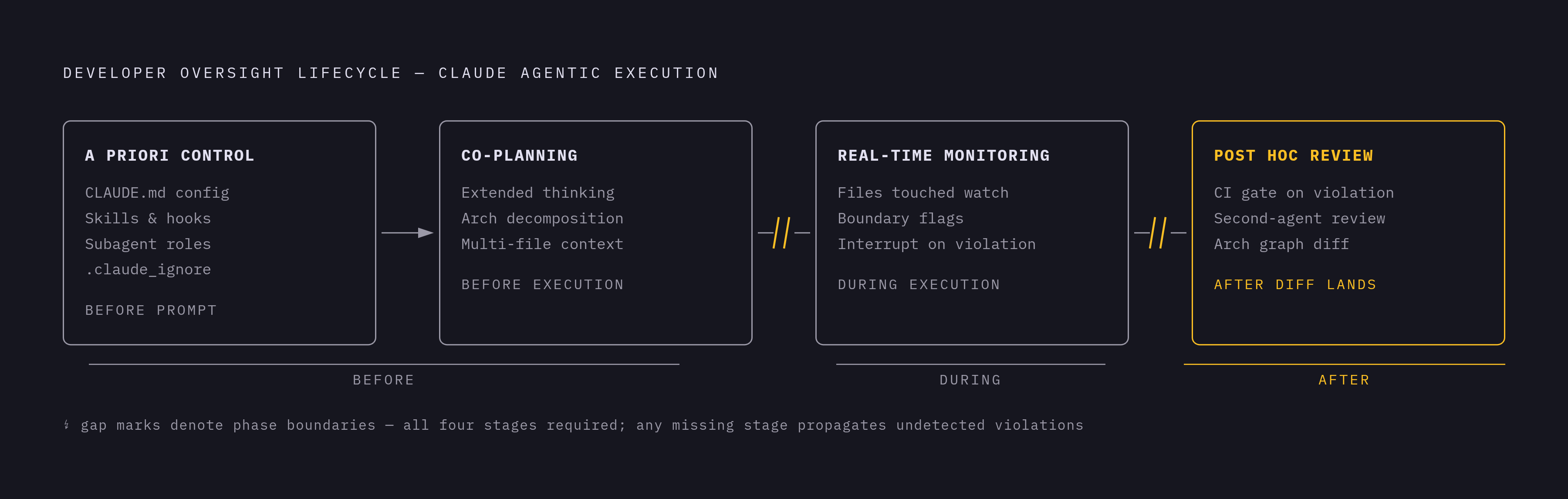
Research from CHI 2026 on experienced developers using agentic tools identifies four forms of oversight. A priori control is configuring before prompting. Co-planning shapes the agent's approach before execution begins. Real-time monitoring steers the agent during execution. Post hoc review evaluates what was built after the fact. All four are necessary, and none is sufficient alone.
These map cleanly onto the developer's role when Claude Code is running. A priori control is the CLAUDE.md constraints, the skill and hook configuration, the subagent role separation, and the.claude_ignore scoping, all done before a single prompt is typed. Co-planning uses Claude Code's extended thinking and its multi-file context awareness to plan architectural changes on the graph before delegating implementation, so it steers the agent's decomposition rather than just its output. Real-time monitoring means watching which files the agent touches, flagging when it crosses a boundary that was not part of the plan, and interrupting before a constraint violation propagates across a large diff. Post hoc review is the CI gate that fails on architectural violations, a second agent or tool reviewing structural impact, and the architecture graph showing what changed at the module level.
The developer who adopts this workflow is not doing less work than before. The work has moved. It is now the work of defining constraints, steering an agent through an architectural plan, and verifying structural change through interfaces that expose it. That is the role the preceding sections have been building toward: architectural work, constraint work, and verification work as the core of the developer's job when the agent is running. The quality of the codebase will be determined less by what the developer types and more by what the developer configured, and refused to allow, before the loop began.