Keeping Architecture Docs Synchronized With Agent-Generated Code
Automate architecture validation into your CI pipeline to catch drift before merge.
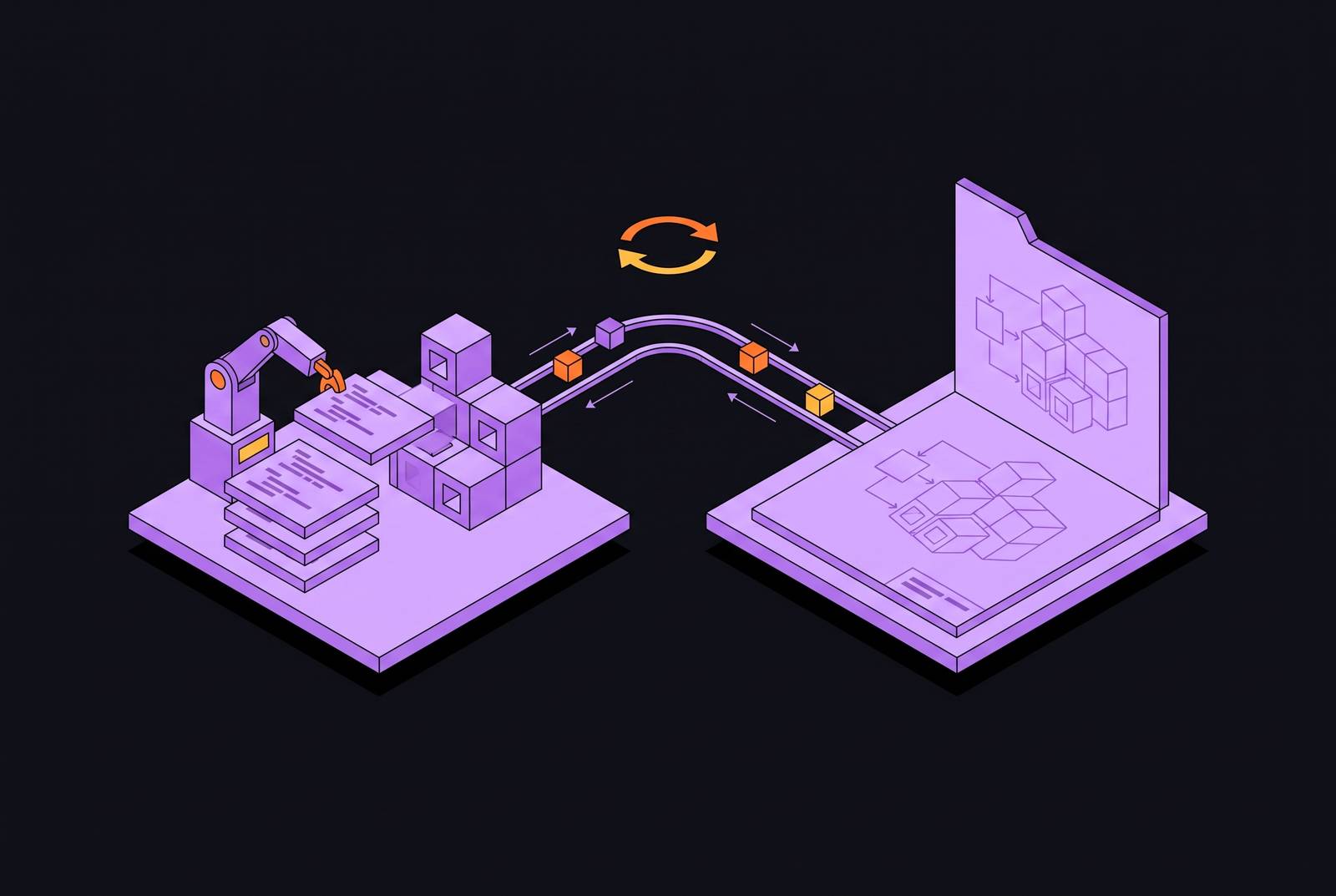
Architecture drift in AI-generated codebases occurs when agent-produced changes diverge from intended structure while documentation still describes an earlier design. Synchronization must become an automated, enforceable property of the development pipeline, with code-derived structure checked against architectural constraints and documentation reviewed when relevant changes occur.
Why architecture docs fall out of sync with agent-generated code
The intuitive diagnosis is that teams just need to be more disciplined about updating docs. That diagnosis fails at agent speed. Agents can touch dozens of files per prompt, while updating an architecture overview requires a person to understand how those changes alter the system as a whole. The mismatch is between the rate of implementation and the mechanism for maintaining its description. Treating it as carelessness assigns a structural problem to individual attention.
A single prompt can scaffold an entire project, choosing frameworks, databases, and deployment targets without those architectural decisions ever surfacing for human review. Those choices establish the structure that later work inherits. Yet architecture changes rarely arrive with a corresponding documentation update, and the overview is especially vulnerable because revising it correctly requires the broadest context. A developer cannot reliably update that account just by reading each changed file on its own. The relationships between the files are part of the change.
Staleness also affects what agents produce next. SDAD (arXiv:2608.20341) describes specification quality as “execution fuel” for agentic delivery, making an outdated specification an active source of misdirection. Agents also draw from code already present in the repository. Once an architectural exception appears often enough, subsequent generation can reinforce it as the normal pattern.
How agent-driven code volume has outpaced human review capacity
Meta’s RADAR paper, presented at ASE in October 2026, showed that both the lines of code per human-landed diff and the number of diffs per developer had grown sharply year over year. Agentic AI was responsible for the majority of that growth. The same paper documented a decline in the share of diffs receiving timely review. These findings place the synchronization problem within an existing review bottleneck, rather than a hypothetical future in which agents become faster.
The pressure comes from two directions at once. Larger diffs increase the amount a reviewer must understand within each change, while greater diff volume increases the number of changes competing for attention. An agent-assisted developer can produce more commits, pull requests, and changed lines per day, but human review capacity does not grow proportionally. A manual synchronization process still depends on someone finding time to connect implementation changes to the system’s intended design.
Architecture documentation is especially likely to fall out of date as that review queue grows. Inline comments and API documentation can be regenerated on demand, whereas an architecture overview requires someone to hold the whole system in mind. Local accuracy is not enough for that task. A description of one API can still help someone use it even when the account of how modules fit together is out of date. Consequently, a process that leaves architecture updates to a later human pass makes drift a near-certainty as generation outpaces review. The scarce resource is not the ability to write more documentation, but the attention needed to reconcile it with a changing system.
Why the current ecosystem of context files and spec docs doesn't solve the drift problem on its own
AGENTS.md, CLAUDE.md, architecture decision records, and architecture.md give agents a starting account of project intent. They remain useful inputs, but they do not themselves establish whether the implementation still matches that account. AGENTS.md is plain Markdown read by a wide range of agents across tens of thousands of repositories. Its recommended sections cover project overview, build and test commands, code style, testing, security, and commit and pull-request rules.
A CLAUDE.md written months earlier may still name a database that the team has since migrated away from. Because agents trust these files by default, that instruction steers the code they generate toward an old design. In this case, stale context is worse than absent context. It supplies a confident answer where the project’s current state calls for a different one.
Teams that use more than one agent environment often repeat rules across CLAUDE.md, AGENTS.md, and other configuration files without a shared source of truth, so the copies can drift apart within weeks. Moreover, these files determine behavior, so an unreviewed edit is a silent policy change applied across every subsequent agent session it touches. Their review requirements follow from their operational role.
SDAD formalizes the upstream discipline as intent capture and machine-readable specification, with specification precision and explicit gates replacing neither engineering judgment nor accountability. Context files express what the agent should do, while validation establishes whether the result complies. Keeping those files current therefore requires the same change triggers and review rigor as keeping code current.
What enforcement-based synchronization actually looks like in practice
The structural alternative is to enforce constraints before generation, immediately after generation, and before merge. Pre-generation enforcement embeds architectural constraints directly in the agent’s context or system prompt. The agent receives the boundaries before it begins producing code. This tier guides the attempt, but an instruction alone cannot establish that the finished implementation obeys it.
Post-generation enforcement uses validators that run immediately after generation and fail when the agent has violated a constraint, catching drift before it enters version control. This separates a stated intention from an independently checked outcome. It also makes architectural compliance part of completing the generation task, rather than something deferred until a person notices a discrepancy. The tier closes the gap between asking for a boundary and checking that the output respects it.
CI validation makes that boundary mandatory at merge. Comprehensive architecture checks run as required, non-bypassable checks, and a violation prevents the build from passing. For the constraints encoded in deterministic tests, adherence is a condition of acceptance rather than a probability that depends on reviewer attention. The scope of those tests remains important. A passing gate establishes compliance within the scope of the rules it checks. Nevertheless, it provides something a memory-dependent doc-review process cannot provide, which is a reliable block on a known violation.
Low-risk changes can move through expedited paths, while high-risk changes require named reviewers with domain expertise. The gate enforces the encoded policy the same way each time, leaving people to review decisions that need architectural judgment. This pairing prevents automated compliance from being confused with approval of the design itself.
DocuWriter demonstrates the corresponding event-driven pattern for documentation. It watches connected repositories, reviews diffs on every push and merged pull request, identifies documents that are now wrong, and opens reviewable suggestions. That trigger model connects documentation work to the event that creates the need for it. It does not replace an architecture gate, because proposing a documentation correction and rejecting a structural violation are different operations.
Why the graph of the codebase is a more reliable sync target than a text document
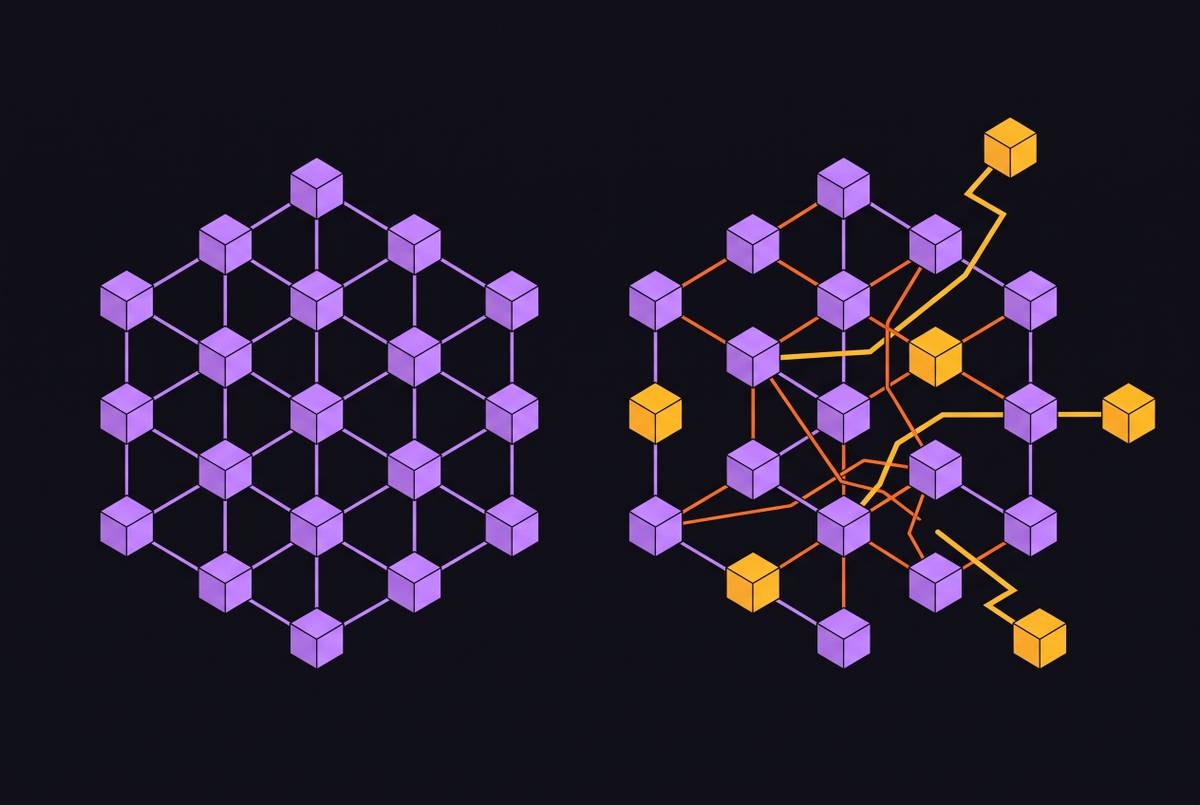
Enforcement needs a precise representation of what changed. A text architecture document records an interpretation of the code at a particular point in time, while a structural graph derived from code records the implementation’s elements and relationships. The distinction is between an account and a computation. A manually maintained overview requires someone to reread and reinterpret the code, but a computed graph can update as the code changes.
A graph can map every module, file, class, function, and call relationship, giving a constraint check concrete objects to compare. A codegraph check, or a similar tool, can run in CI, compare the current graph against the intended architecture, and exit non-zero when it finds a violation. The pipeline can then reject the change. A written rule becomes enforceable because both the rule and the implementation have a form the check can evaluate.
Deriving a map from code establishes only what the repository contains. Otherwise, every departure would simply become part of the newly generated description, reproducing the feedback loop in which exceptions become normal. The graph supplies observed structure, while the specification supplies the constraints against which that structure is judged. Detection depends on comparing observed structure against specified constraints.
SDAD describes the “Ambiguity Tax” as the exponential cost of vague specifications as clarity decreases. A structural graph removes ambiguity about what the codebase contains within its mapped elements and relationships, independent of what a document claims. The reasons for design choices still belong in architectural intent and decision records, while the live map provides the factual basis for the overview. Generating that structural account from live analysis removes the burden of manually reconstructing relationships each time the implementation changes.
How developers' work changes when sync is structural rather than manual
Once structural checks do the repeated work of checking compliance, developers can have more influence by setting and updating the constraints themselves. SDAD calls this role metamorphosis, describing the engineer as a “Spec Architect” whose contribution rests on the precision and coverage of specifications. This moves engineering judgment to the point where it can shape repeated agent output.
Architecture and specification work therefore becomes a primary interface for directing implementation. The specification states the intended boundaries, and the graph makes the resulting structure available for comparison. The diff remains a record of changes, but it is no longer the sole place where a developer must recover architectural intent. That distinction changes the purpose of review. Developers assess whether the constraints express the right design and whether a proposed change warrants revising them, rather than repeatedly reconstructing rules from scattered implementation details.
For teams making this shift, context files become artifacts reviewed when the architecture changes. The CI gate makes conflict with encoded constraints immediately visible. This can sound like additional process at first. However, bounded automated checks replace open-ended manual reconciliation, and a gate that catches a layer violation in thirty seconds replaces a post-hoc architecture review that might not happen at all. The work is attached to a defined event and a specific discrepancy.
Developers define constraints, review high-risk decisions, and revise intent when the architecture needs to evolve. The structural map supplies the current account of the code, and enforcement measures each agent run against the intended boundaries. Across the day and week, this leaves more time for deciding how the system should fit together and less time repairing the gap between what its documentation says and what its code has become.